Which Foods Actually Trigger Gout? The Standard List Gets Vegetables, Cheese and Fish Wrong
Most people diagnosed with gout leave the appointment holding a printed list of foods to avoid. Parts of that list are decades old, and parts of it are simply wrong — wrong in the specific sense that the foods named have been studied and found not to raise risk.
That matters more than it sounds. A list that forbids spinach, mushrooms and salmon while saying little about fructose sends people away from foods that were never the problem, and leaves the actual drivers untouched.
Purines are the mechanism, not the whole story
Purines are the portion of food that comes from the cell nucleus — the nucleic acids, DNA and RNA. The liver converts them to uric acid, and the kidneys are meant to excrete it. Gout follows either from producing too much or from clearing too little. We covered that machinery in detail in gout, uric acid and the keto/carnivore diet.
The standard food list treats purine content as if it were the entire equation. It is not. What matters is how much of a food’s purine load actually reaches the bloodstream as urate, and what else that food does to your ability to excrete it.
The vegetable myth
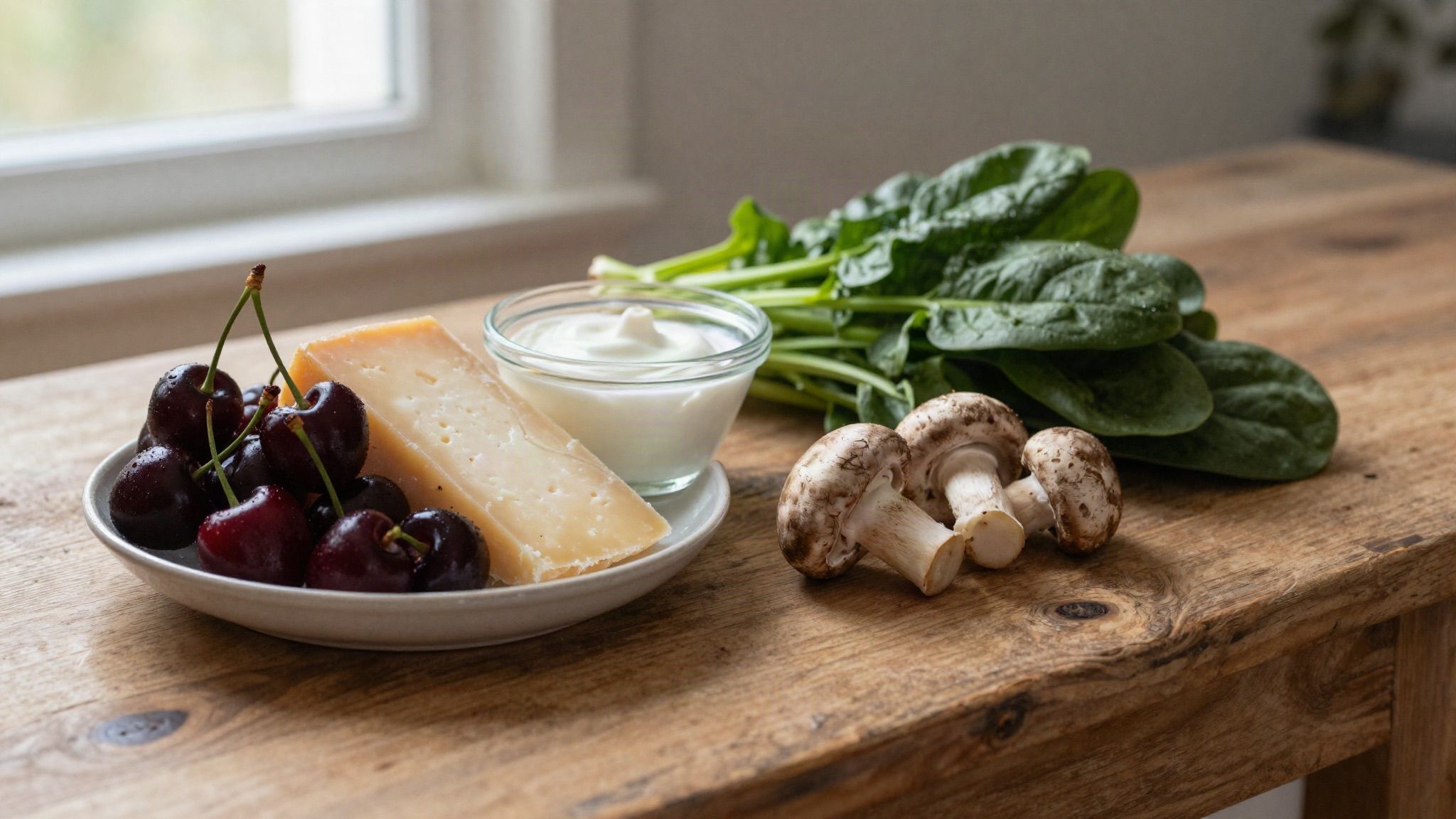
Spinach, asparagus, mushrooms, cauliflower, peas and lentils appear on almost every gout handout because they are, measured in a laboratory, relatively high in purines.
When this was actually tested in a large cohort of men followed over twelve years, purine-rich vegetables showed no association with an increased risk of gout. Animal-source purines did. Vegetables did not.
The likely reasons are not mysterious. Plant purines are less bioavailable. The foods carrying them come with fibre, potassium and water. And they tend to have an alkalinising effect on urine, which favours urate excretion rather than crystal formation — the same principle behind the sodium bicarbonate protocol we use clinically.
Cheese and dairy appear to be protective
The same research found dairy intake inversely associated with gout risk — more dairy, less gout — with low-fat dairy showing the strongest relationship. The proposed mechanism is that the milk proteins casein and lactalbumin promote uric acid excretion.
So “is cheese bad for gout?” has an unexpected answer: on the evidence, dairy is one of the few food groups associated with lower risk. If a particular cheese reliably precedes your own flares, trust that observation — but the blanket instruction to avoid dairy has the research pointing the other way.
Fish: the nuance that blanket advice destroys
Seafood does raise risk, and that finding is consistent. But “avoid all fish” throws away the omega-3 intake of people who often have significant inflammation and cardiovascular risk alongside their gout. The purine load is not evenly spread:
- Highest: anchovies, sardines, herring, mackerel, mussels, scallops, and fish roe. These are the genuine offenders, and they are concentrated small fish eaten whole.
- Moderate: tuna, salmon, trout, halibut, prawns. Worth portioning rather than eliminating — a normal serving of salmon is not in the same category as a tin of anchovies.
- Lower: most white fish in ordinary portions.
For most people the workable position is to keep the moderate group at sensible portions, eat the highest group rarely, and not to sacrifice omega-3 intake out of caution about salmon.
The two things that actually move uric acid for most people
If the handout mentioned only two items, these are the two it should mention.
Fructose
Fructose is the only common carbohydrate whose metabolism consumes ATP rapidly enough to generate urate as a by-product. Sugar-sweetened soft drinks and fructose intake have been associated with a substantially increased risk of gout in men, and high-fructose corn syrup is the concentrated form most people encounter. Fruit juice belongs in this conversation; whole fruit, with its fibre and water, is a different proposition.
Alcohol, and beer in particular
Alcohol works on both sides of the equation: it impairs uric acid excretion, and beer additionally carries a purine load from brewer’s yeast. When alcohol types were compared directly, the risk gradient ran beer first, then spirits, with wine showing little association at moderate intake.
A practical tier list
- Eat freely: vegetables of any purine content, most fruit, dairy, eggs, coffee, water.
- Portion sensibly: red meat, salmon and tuna, prawns, poultry, wine.
- Treat as triggers: sugar-sweetened drinks and fruit juice, beer and spirits, organ meats, anchovies and sardines, and any period of dehydration.
Notice that the last item is not a food. Uric acid harms by concentration, so hydration status changes the result of everything else on the list. Poor sleep, illness, and rapid weight loss can all precipitate an attack in someone whose diet has not changed at all.
When an attack starts at night
Acute gout is a medical problem and deserves to be treated as one. If you have been prescribed urate-lowering therapy, none of this replaces it, and a first attack should be assessed properly rather than self-managed — several conditions imitate gout, including one, septic arthritis, that is an emergency.
What we do use clinically alongside proper treatment is described in the keto and gout article: aggressive hydration with electrolytes, and sodium bicarbonate to alkalinise urine — starting at an eighth of a teaspoon in water on an empty stomach, building gradually, and away from food.
References
- Choi, H. K., Atkinson, K., Karlson, E. W., Willett, W., & Curhan, G. (2004). Purine-rich foods, dairy and protein intake, and the risk of gout in men. New England Journal of Medicine, 350(11), 1093–1103. https://doi.org/10.1056/NEJMoa035700
- Choi, H. K., Atkinson, K., Karlson, E. W., Willett, W., & Curhan, G. (2004). Alcohol intake and risk of incident gout in men: a prospective study. The Lancet, 363(9417), 1277–1281. https://doi.org/10.1016/S0140-6736(04)16000-5
- Choi, H. K., & Curhan, G. (2008). Soft drinks, fructose consumption, and the risk of gout in men: prospective cohort study. BMJ, 336(7639), 309–312. https://doi.org/10.1136/bmj.39449.819271.BE
- Dalbeth, N., Merriman, T. R., & Stamp, L. K. (2016). Gout. The Lancet, 388(10055), 2039–2052. https://doi.org/10.1016/S0140-6736(16)00346-9
Want to learn more about optimizing your health and longevity? Visit our Blog Home Page for more expert insights. If you’re interested in working directly with Dr. G to see if you’re an ideal client, you can explore more here.