How to Increase Ferritin Levels When Iron Supplements Are Not Working
How to increase ferritin levels usually comes down to three things: the form of iron you’re taking, the cofactors it needs alongside it, and whether something in your gut or your diet is blocking absorption. Dose is the last thing I look at.
A question came up in the last Reset Room session that I get in some version most weeks. Ferritin sitting at 44. Iron bisglycinate taken faithfully. The rest of the iron panel looking respectable. And the ferritin refusing to move. She’d switched to a 20 mg heme iron product, read somewhere that she shouldn’t be taking iron with coffee or dairy, and wanted to know whether to take both supplements together.
The answer she was expecting was a dose. The answer she needed was a list of reasons a perfectly reasonable supplement produces nothing.
Why is your iron supplement not increasing your ferritin levels?
Usually one of four things. The iron is in a form you absorb poorly. It’s missing the cofactors it needs to get across the gut wall. Something in your diet or your digestion is blocking it. Or inflammation is distorting the number you’re reading.
I use a simple frame for this with patients, and it applies to almost every nutrient. It’s the sufficiency and interference model. Am I deficient in something I need more of, and is there something interfering with normal function? Those are two different problems with two different solutions, and people almost always assume they have the first one.
Here’s how you tell them apart. A vegetarian with low ferritin is insufficient in iron. A person who eats red meat five times a week and still has low ferritin has interference. It isn’t that you are what you eat. You are what you eat, digest and absorb. Adding a second supplement to an absorption problem gets you a more expensive absorption problem.
What should your ferritin actually be?
We target 75 to 100 on the lab report. Many laboratory reference ranges start somewhere in the teens, which means a ferritin of 30 comes back flagged as normal while the person carrying it is exhausted, foggy and being told their bloodwork is fine.
Ferritin is the storage form of iron, and storage is the thing you actually want to know about when you’re trying to refill a reserve.
Which other iron markers should you look at?
Four numbers, and each one answers a different question. Serum iron is what’s floating in your blood right now. Percent saturation is how much of your carrying capacity is filled. Ferritin is what’s in storage. Total iron binding capacity, or TIBC, is your thirst for iron.
- Serum iron. Below 75 is low. Above 100 we don’t really want to see either.
- Percent saturation, sometimes reported as transferrin saturation. It should be above 20. I used to say 25 to 35; these days I’d call low 20s to high 30s the sweet spot. Above 40 is a problem in the other direction.
- Ferritin. Storage. 75 to 100.
- TIBC. When this climbs above 350, your body is asking for more iron. That number usually drops once you have enough, sometimes to the point of coming back laboratory low. On its own a TIBC of 375 means nothing much to me. Sitting next to a low ferritin, it tells me you need more iron.
The upper limits are not arbitrary. Iron floating around unbound will rust, and we call that rusting oxidation. If your serum iron climbs above 100 and your saturation goes above 40, what you’ve added is reactive iron in circulation, and your stores are no better off for it. So a bigger dose is almost never the fix for a stuck ferritin.
Is heme or non-heme iron better absorbed?
Heme, by a wide margin. In the absorption literature, heme iron gets taken up at somewhere around 15 to 35 percent depending on the meal, while non-heme iron runs anywhere from 2 to 20 percent and is far more sensitive to whatever else is on the plate. Heme means blood, and it’s the form iron comes in inside animal tissue. It’s what makes red meat red, and we’re built to absorb it.
Non-heme iron is the elemental form. It’s what’s in plants, in fortified cereals, and in most of the cheap iron sitting on the pharmacy shelf. It isn’t iron in the sense your cast iron skillet is iron, but it needs a great deal more help to get where it’s going.
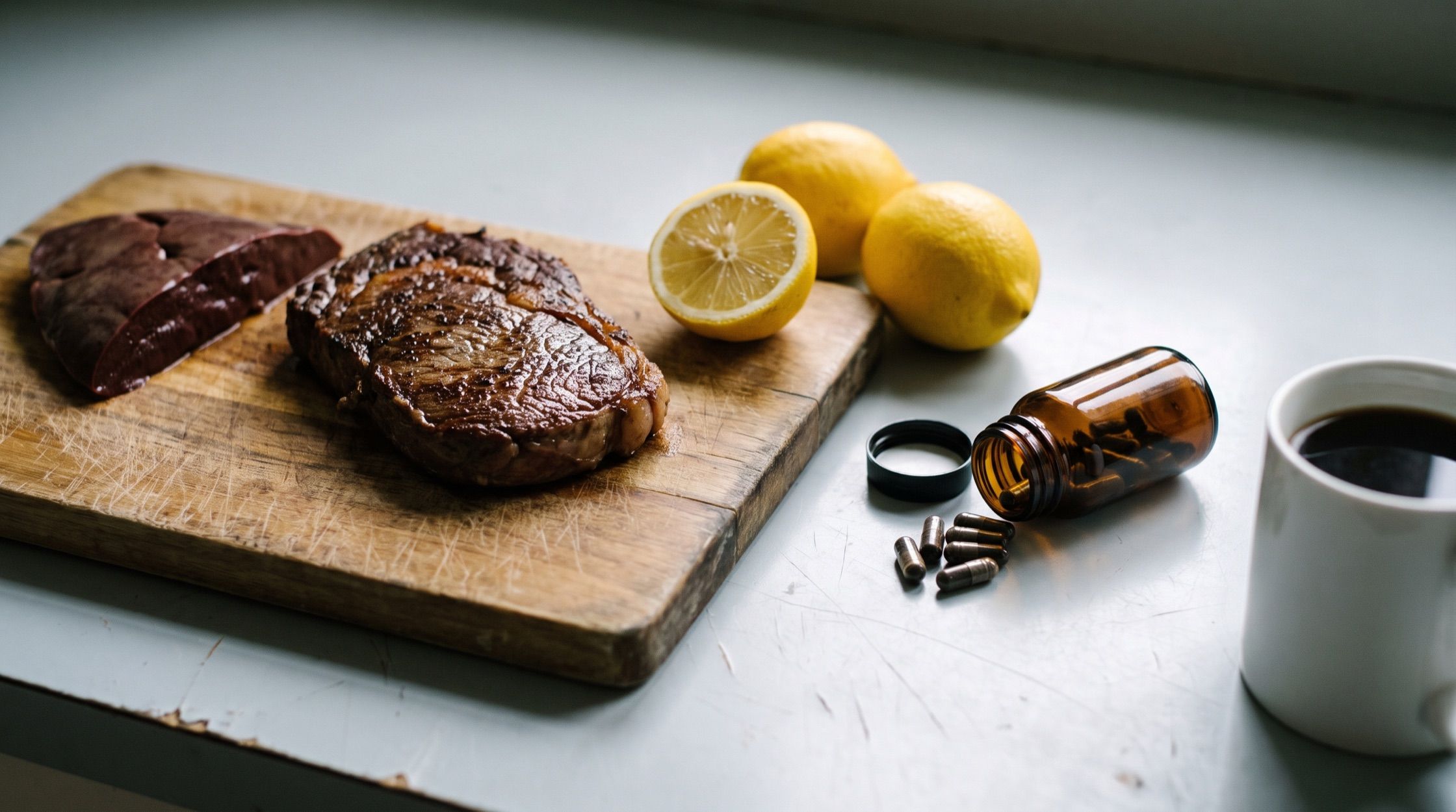
So start with food. The bottle comes later, if at all. Iron typically comes from animal products, and red meat is the most important one. Organ meat carries even more, which is why the desiccated liver capsules people are taking do genuinely supply heme iron. Eating liver works too, if you can face it.
If supplementation is still necessary once the diet is right, take it in the heme form where you can. Her instinct to switch was correct.
What does iron need alongside it to be absorbed?
Before anything goes into a capsule: get a panel and confirm you are actually low. Iron overload is a real condition, hereditary hemochromatosis is more common than most people assume, and pouring iron into a body that is already loading it does harm. Symptoms alone are not enough to justify supplementing.
Assuming you are low, look for 27 mg of iron bisglycinate with 50 to 80 mg of vitamin C and 200 to 300 mg of betaine HCl in the same capsule. Bisglycinate on its own won’t get you there.
Vitamin C is the well-established one. It reduces iron into the form the gut can take up and holds it soluble long enough for that to happen, which is why the ascorbic acid content of a meal changes how much iron you get out of it.
Betaine HCl is the piece most products leave out, and it gets described loosely, including by me in the session. It’s often called a digestive enzyme. It’s simpler than that: it supplies hydrochloric acid and lowers the pH in your stomach. Iron is absorbed high in the GI tract and needs an acid environment there to stay soluble. In my patients the acid side is where this usually falls down, which is why I want betaine HCl in the formula. I’ll be straight with you that this is clinical practice rather than a trial result; there is no human study showing betaine HCl raises ferritin. And one caution: if you’re on acid-suppressing medication, or you have a history of ulcer or reflux, don’t start betaine HCl without talking to whoever prescribes for you.
Read the label on what you’re already taking. A lot of iron supplements are a single ingredient in a capsule, and a single ingredient in a capsule is what a stuck ferritin usually looks like.
What blocks iron absorption without you noticing?
Coffee and tea, calcium, low stomach acid, and inflammation in the gut itself. None of these announce themselves. You take the supplement, you tick the box, and the iron never makes it in.
- Polyphenols in coffee and tea. When Hurrell’s group tested this, a cup of coffee taken with a meal cut non-heme iron absorption sharply, and tea was worse. One limitation to be honest about: that was radio-labeled iron in a bread meal, not an iron capsule, so how much of the effect carries over to a supplement hasn’t been measured.
- Calcium. Within a single meal it interferes with both heme and non-heme iron, which makes it the one mineral that gets in the way of the good form too. The longer picture is softer: supplementation trials running over months haven’t shown calcium changing iron status. So separate them if it’s easy. It’s a cheap precaution, and the evidence behind it is thinner than the confidence with which it usually gets repeated.
- Low stomach acid. Common, under-recognized, and easy to miss because nobody routinely tests for it.
- An inflamed gut. SIBO, colitis, IBD and Crohn’s all compromise absorption at the site where absorption happens. Fix the gut and the same supplement starts working.
In practice: take your iron away from coffee and away from dairy, and take it where there’s some acid to work with. The woman who asked me this had been taking hers with both, which is a reasonable candidate for why the supplementing produced nothing.
Why does inflammation push your ferritin up?
Because ferritin is an acute phase reactant, and it goes up whenever it’s reacting to inflammation: a virus, a bacterial infection, a chronic inflammatory condition, or me kicking you in the shins. Your body is doing something sensible when it happens. It pulls iron out of your blood and locks it away as ferritin so the pathogen can’t use it, which starves the infection of the iron it wants.
So the classic inflammatory presentation is low serum iron, low percent saturation, and high ferritin. If you see that combination, the high ferritin is not good news about your iron stores.
It cuts the other way too, which is the part that surprised her. If you have inflammation, a ferritin of 44 is already a higher number than you’d otherwise be carrying, so your true reserves are lower than 44. The way to check is the company the number keeps. Serum iron below 75 and percent saturation below 20 sitting alongside it, and there’s a good chance the ferritin number belongs to the inflammation, not to your iron stores.
If you’re still at the stage of working out what your results mean, I’ve gone through that separately in low ferritin with normal hemoglobin, which covers what each marker is telling you and how a normal-looking blood count can sit on top of an empty reserve.
How do you increase ferritin levels that will not move?
Slowly. Ferritin is the storage compartment, so it refills after everything else has improved. Red blood cells live roughly 120 days, and the reserve fills in behind them. Most clinicians retest at around three months, and running the whole panel at that point tells you far more than checking ferritin on its own at three weeks.
What I’d avoid is stacking products and hoping. Adding a heme supplement on top of a bisglycinate supplement changes the total dose without addressing a single one of the four reasons the first one failed. Fix the form, add the cofactors, move it away from coffee and dairy, and get the diet carrying its share first. Supplements are a tool to get you from where you are to where you need to be. It’s never what’s in the plastic bottle that makes you healthy.
And if the panel still hasn’t moved after a proper trial with all of that in place, the question stops being about the supplement. Persistent iron deficiency despite adequate intake and absorption support needs a physician’s workup, because ongoing blood loss and malabsorptive conditions like celiac disease sit behind a meaningful share of these cases and no capsule addresses either.
This is general education about how to read an iron panel, not individual medical advice, and nothing here is a reason to change or stop anything your own doctor has prescribed. Bring your actual numbers to someone who can put them in context. Context is the one thing a search result can’t give you.
References
- Hurrell, R., & Egli, I. (2010). Iron bioavailability and dietary reference values. American Journal of Clinical Nutrition, 91(5), 1461S-1467S. https://doi.org/10.3945/ajcn.2010.28674F
- Hurrell, R. F., Reddy, M., & Cook, J. D. (1999). Inhibition of non-haem iron absorption in man by polyphenolic-containing beverages. British Journal of Nutrition, 81(4), 289-295.
- Hallberg, L., Brune, M., Erlandsson, M., Sandberg, A. S., & Rossander-Hulten, L. (1991). Calcium: effect of different amounts on nonheme- and heme-iron absorption in humans. American Journal of Clinical Nutrition, 53(1), 112-119. https://doi.org/10.1093/ajcn/53.1.112
- Hallberg, L., Brune, M., & Rossander, L. (1989). The role of vitamin C in iron absorption. International Journal for Vitamin and Nutrition Research. Supplement, 30, 103-108.
- Ganz, T. (2011). Hepcidin and iron regulation, 10 years later. Blood, 117(17), 4425-4433. https://doi.org/10.1182/blood-2011-01-258467
- Camaschella, C. (2015). Iron-deficiency anemia. New England Journal of Medicine, 372(19), 1832-1843. https://doi.org/10.1056/NEJMra1401038
- Cullis, J. O., Fitzsimons, E. J., Griffiths, W. J., Tsochatzis, E., & Thomas, D. W. (2018). Investigation and management of a raised serum ferritin. British Journal of Haematology, 181(3), 331-340. https://doi.org/10.1111/bjh.15166