Is It Bad to Eat Before Bed? What a Late Hunger Signal Means

Is it bad to eat before bed? A member asked me exactly that on a live call last month, and he was almost apologetic about it. His first meal is at 1 p.m. His last is at 7. In between it’s fruit, vegetables, nuts, legumes, all sensible. He goes to bed around 11:30. And every night before he does, he eats a plum or a nectarine.
He wanted to know whether he was wrecking something. His way of putting it was, “I think I’m fasting, but I’m not fasting.” He told me he’d never asked anybody else about it, which I suspect means he assumed the answer would be no.
My first question back wasn’t about the fruit. It was: do you sleep well? He said he sleeps solid. His A1c is 5.4 and his fasting insulin is a little under 2. At that point the answer had already arrived, and it wasn’t the one he was bracing for.
Is it bad to eat before bed?
Not by itself. It becomes a problem when the food is large or sugary, or when you’re eating because your blood sugar crashed and you have no choice. A small, deliberate snack in a metabolically healthy person is neither of those.
Two things matter: what you eat, and why you wanted it. A plum at eleven at night and a bowl of ice cream at eleven at night are not the same event. If he’d told me he finishes every day with ice cream, that’s a different story, and it isn’t really a story about timing.
Then there’s the gap. Finishing dinner at 7 and getting into bed at 11:30 is four and a half hours of nothing, followed by another seven or eight asleep. That’s a long stretch to ask a body to cover with no fuel arriving, especially on a day when carbohydrate intake was modest. So the nectarine isn’t a discipline problem. It’s arithmetic.
Late hunger is a fuel signal
Either the gap between your last meal and your bed is too long, or your body can’t yet switch over to burning fat fast enough to cover the dip. Hunger at eleven is telling you something about your metabolism, and it’s usually information you want.
Here’s the machinery underneath it. Fat in your diet and fat on your body is stored as triglycerides: a three-carbon backbone with a fatty acid hanging off each carbon. Break that apart and the fatty acids float free. The three-carbon backbone is what your body uses to manufacture sugar. The three fatty acids are what it uses to manufacture ketones. Two different fuels, made from the same molecule.
Those two routes feel completely different from the inside. Manufacturing sugar out of your own tissue requires a stress hormone to do it. You need cortisol, and often adrenaline alongside it. That’s the route that produces the anxious, edgy, hangry state everybody recognizes from the Snickers commercials. Making ketones instead does none of that. Think of it as the difference between the high-octane gas you put in a race car and the diesel you put in a long-haul truck. One gives you a burst. The other gives you long, steady energy.
If you’ve spent decades running mostly on a steady supply of carbohydrate, the ketone route is rusty. The capacity is always there, but it needs time to come up. Metabolic flexibility takes weeks to months depending on the person. Somebody who drops to 25 or 30 grams of carbohydrate a day and still feels shaky in the evening after 48 hours hasn’t failed at anything. They’ve asked a system that hasn’t been used properly in years to come online in two days.
What happens to your blood sugar overnight?
It falls, and your body holds the floor by making its own. That’s the part people skip over: manufacturing sugar out of your own tissue takes a stress hormone to do it. Mostly cortisol.
Does that explain the broken sleep some people get in the back third of the night? I think it’s part of the story in some of them. I want to be straight with you that this is a clinical hunch and not something I can hand you a paper for.
Two things make the overnight job harder than it needs to be. Glucose tolerance is genuinely poorer in the evening than in the morning, which the circadian literature has described for decades (Van Cauter 1997), so an identical meal produces a bigger swing at 10 p.m. than it does at 10 a.m. And belly fat carries receptors that take inactive cortisone and switch it on locally, so the more visceral fat you’re carrying, the more you amplify whatever stress signal shows up. Belly fat is an active organ. It joins in.
When a bedtime snack is the right call
Another member on that same call had been struggling with the last third of the night, the late-stage sleep quality that never quite holds. I gave him two options: a teaspoon of raw honey just before sleep, or half a piece of fruit with peanut butter. He tried the honey. He came back and told me he’d had the best sleep of his life, a 91 on the sleep score he tracks, and slept through until 6:30, which he said never happens.
That’s one night in one person, and he was the first to say so. But it’s the same thing the man with the nectarine had worked out on his own without ever knowing why. His body was asking for a small amount of fuel to get through the night, and he’d been supplying it for years. That’s his body telling him to do something in a very intelligent way.
So the test is your sleep. If the back third of your night is broken and you can’t get back down, or your last meal was five or six hours before bed, a small snack is a reasonable thing to try. Early in a low-carbohydrate transition, when you aren’t making ketones well yet, it’s almost expected.
The reverse test matters just as much. If you sleep solid, your fasting insulin sits where it should, and your A1c is fine, the snack isn’t the thing to fix. I don’t like calling anyone metabolically healthy off a single marker, and I’d want liver enzymes and triglycerides in front of me too. But when the picture holds together, I’m not going to interfere with something that’s clearly working.
People also ask whether late hunger means they simply aren’t eating enough. Cravings can be a measure of that, but the measure gets unreliable in someone who’s metabolically unhealthy. Past 50, strength is the better read. Know your grip strength. Know your hang time. Make sure you aren’t losing strength year over year. That tells you more about whether you’re underfed than any craving will.
What the snack should be
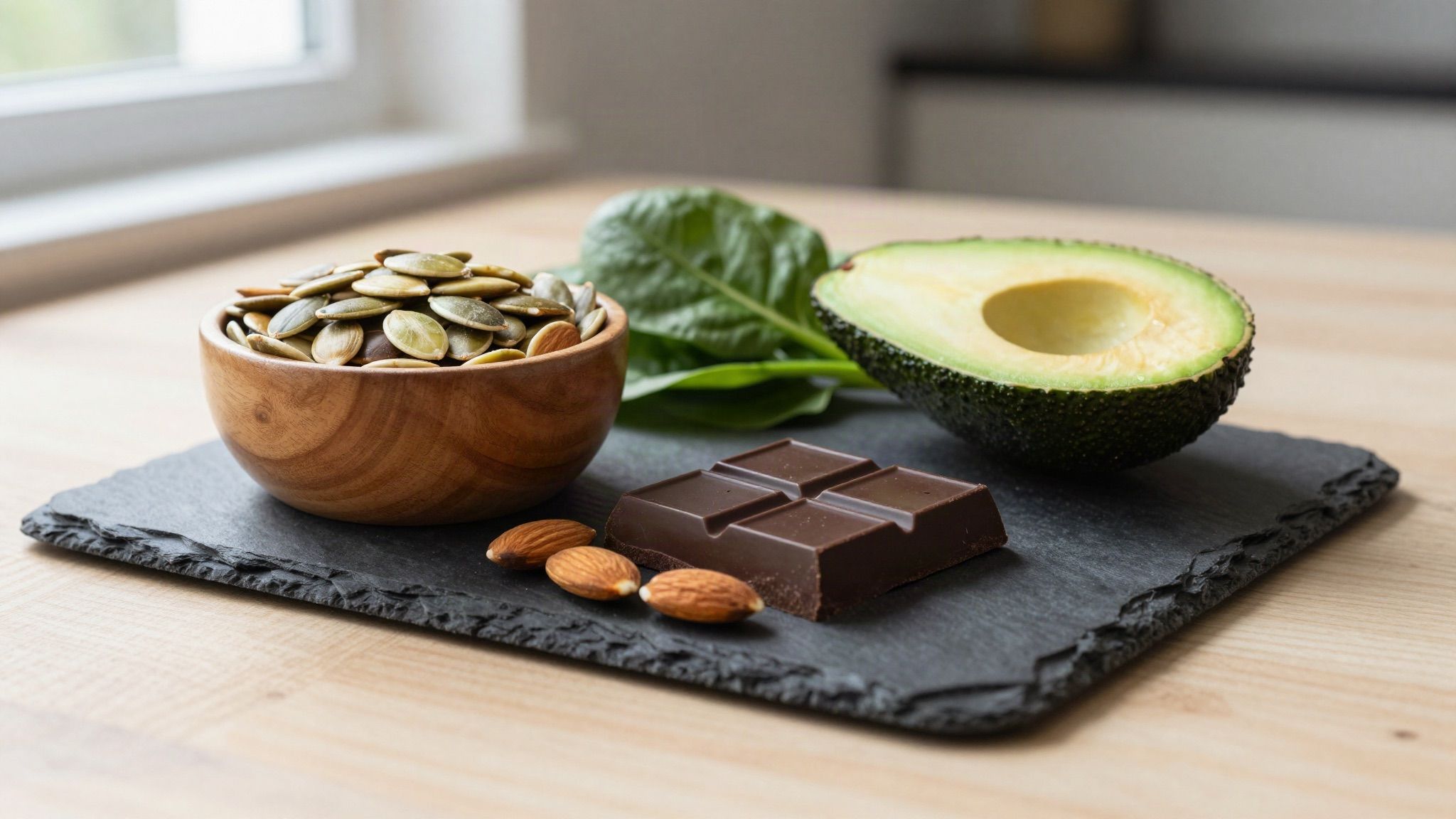
Small, and built to hold blood sugar level instead of spiking it. A teaspoon of raw honey. Half a piece of fruit with a spoon of peanut butter. A plum, a nectarine, a small handful of nuts. A bridge to morning, that’s all.
Carbohydrate on its own lifts your blood sugar and then lets it drop away again. A little fat or protein alongside it flattens the curve. That’s general nutrition, and it’s why the fruit-with-peanut-butter version works better than a bowl of cereal.
One thing I’d keep well away from bedtime is an exogenous ketone supplement. We do use those inside the programme, with members whose history and blood chemistry I’ve actually looked at: usually 10 grams of ketones with 10 grams of creatine monohydrate for the first 90 days or so, while their own fat-burning machinery catches up. That’s a supervised decision, and I’ll say what I always say, which is that without a blood test you don’t know anything. The part that applies to everybody is simpler. Most of those products carry a little caffeine, so the right slot for them is during your morning fast. If you’re breaking your fast at 11, take it around 8:30 or 9. Never at 11 at night.
Moving the whole day earlier
Same eating window, better placement. First meal at 11, last meal at 5:30 or 6, in bed by 9:30 and asleep by ten. Close the four-hour gap between dinner and sleep and the late hunger usually stops asking on its own.
That’s what I suggested to him, with one caveat. He may not notice a difference at all, and if nothing is bothering him, I wouldn’t mess with a routine that’s working. Shifting earlier is fine-tuning at this point. He isn’t in any trouble.
One small controlled trial points in that direction. Eight men with prediabetes ate on a six-hour window with dinner finished before 3 p.m., and their insulin sensitivity, blood pressure and markers of oxidative stress improved with no significant weight change (Sutton 2018). Eight men is eight men, and that protocol is far more aggressive than anything I’m suggesting here. Finishing your last bite at 3 in the afternoon is a different life from finishing at 5:30. What I take from it is only the direction.
How long should the overnight fast be? On the call I said twelve hours is probably the minimum, and I mean that as a floor worth aiming for rather than a cliff you fall off the moment you go under it. Thirteen feels natural to most people. Fourteen, honestly, is barely a stretch.
The Ramadan research interests me because it’s such an awkward test case. The eating happens late, after sundown, and the metabolic markers still shift in a good direction (Faris 2020). Hold two things alongside that. Most of those studies are before-and-after with no control group, confounded by everything else that changes during Ramadan, and the effects largely revert afterwards. And the fast length itself varies enormously with latitude and season. I’ve quoted 13 hours on calls, which is my own recollection rather than something that meta-analysis pins down.
The other half of the job is building the machinery. Zone two exercise does that: long duration, low intensity, the pace where somebody calling your cell phone would hear you huffing a little but you could still hold the conversation. Three hours a week, in sessions never shorter than 30 minutes. Six 30-minute walks, four 45-minute ones, two 90-minute ones, whatever fits. Fasted in the morning is the best version. Zone two is where you burn free fatty acids without having to manufacture sugar. Whether building that capacity also quiets late-night hunger is my working assumption, and I’ll flag it as an assumption, because I can’t point you to a trial that tested it.
Give that weeks. Two days of low carbohydrate tells you almost nothing except that your body noticed.
So, is it bad to eat before bed? The more useful question is why your body is asking at that hour. If the answer is that you stopped eating six hours ago and you’re about to sleep for eight more, a plum is a sensible response to a sensible request. If the answer is that your blood sugar crashes every evening and always has, the snack is managing a symptom, and the pattern underneath it is the thing to work on.
This is general education, not individual medical advice. If you take medication that affects blood sugar, changing when you eat can change how that medication behaves, so make those changes with the clinician who prescribed it.
References
- Sutton, E. F., Beyl, R., Early, K. S., Cefalu, W. T., Ravussin, E., & Peterson, C. M. (2018). Early time-restricted feeding improves insulin sensitivity, blood pressure, and oxidative stress even without weight loss in men with prediabetes. Cell Metabolism, 27(6), 1212–1221. https://doi.org/10.1016/j.cmet.2018.04.010
- Van Cauter, E., Polonsky, K. S., & Scheen, A. J. (1997). Roles of circadian rhythmicity and sleep in human glucose regulation. Endocrine Reviews, 18(5), 716–738.
- Faris, M. A. I. E., Jahrami, H. A., Alsibai, J., & Obaideen, A. A. (2020). Impact of Ramadan diurnal intermittent fasting on the metabolic syndrome components in healthy, non-athletic Muslim people aged over 15 years: a systematic review and meta-analysis. British Journal of Nutrition, 123(1), 1–22.
Want to learn more about optimizing your health and longevity? Visit our Blog Home Page for more expert insights. If you’re interested in working directly with Dr. G to see if you’re an ideal client, you can explore more here.