NAC and Alcohol: Does It Protect Your Liver If You Drink?
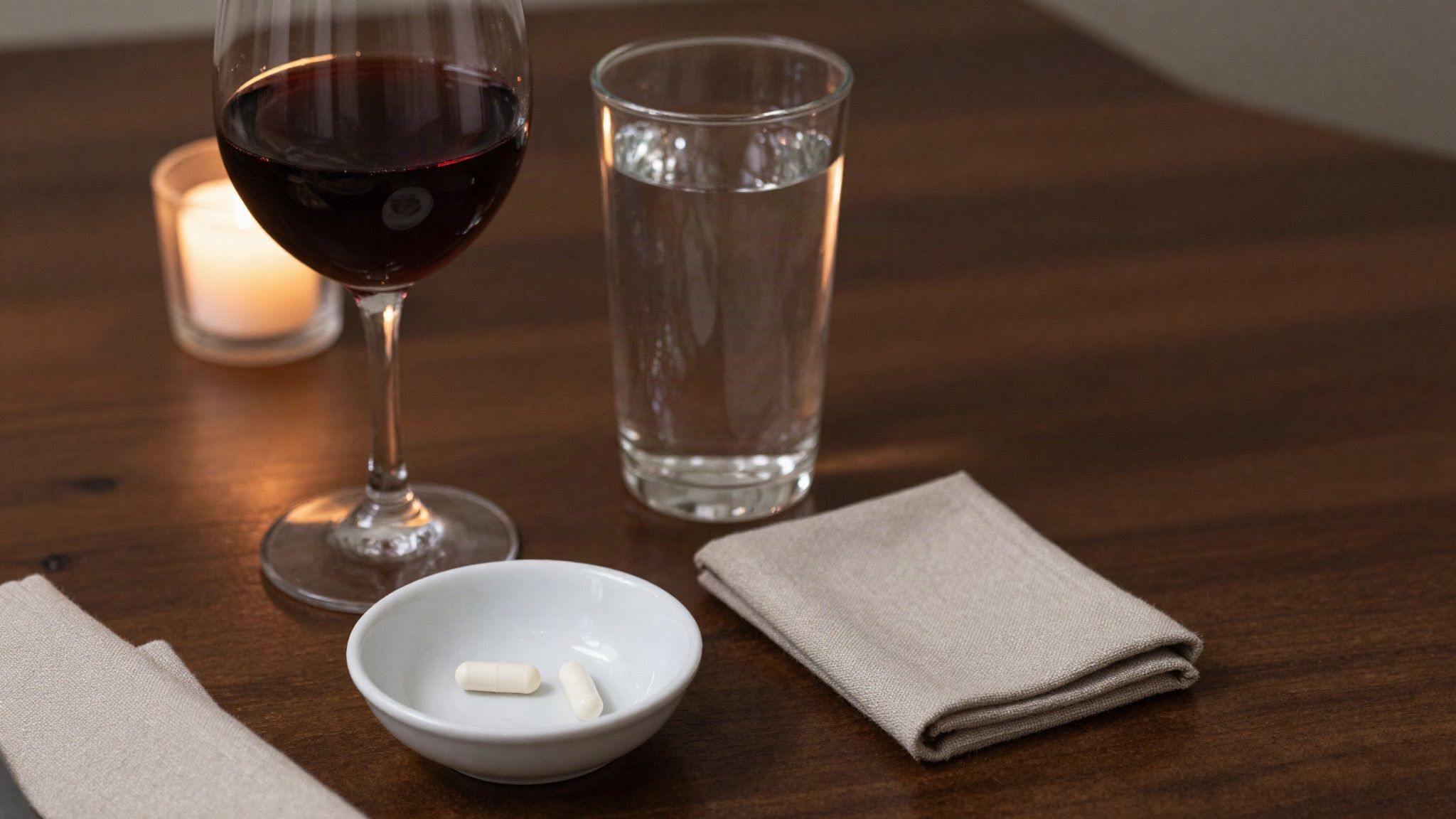
Most of the questions I get about NAC have alcohol somewhere in them. Does it protect the liver? Should I take it if I drink most weeks? Before or after? The mechanism is simple, and once you’ve got it you can see both what NAC can do for a drinker and where it stops.
I’ve written about NAC and hangovers before. This one is about the longer game: what regular drinking does to the liver, and where N-acetylcysteine fits for someone who isn’t going to stop.
What does alcohol do to your liver?
Alcohol is broken down in the liver in two steps, and the middle step produces a compound more toxic than the alcohol itself. Your liver clears that compound with glutathione, and regular drinking uses glutathione faster than the liver can rebuild it.
Step one turns ethanol into acetaldehyde. Acetaldehyde is reactive, damages proteins and DNA, and drives much of what a hangover feels like. Step two turns acetaldehyde into acetate, which is harmless, and the body burns it off. A healthy liver does this every day without complaint.
Two things change when the drinking is regular. First, the liver switches on a second enzyme pathway, CYP2E1, to help keep up. That pathway does the job but throws off free radicals as it goes, and free radicals are what oxidative stress means in practice. Second, the liver’s supply of glutathione, its main defense against those free radicals, falls. Chronic drinking measurably lowers it, and the loss is worst inside the mitochondria of liver cells, where the damage matters most.
That’s the setting for a regular drinker: a liver that spends years slightly behind on its repair budget. Fatty liver is the first visible result, and it’s common enough that most people carrying it have no idea.
How do NAC and alcohol interact?
NAC supplies cysteine, the amino acid glutathione runs out of first. More cysteine means the liver can rebuild glutathione faster, which means more capacity to clear acetaldehyde and mop up the free radicals alcohol generates. That’s the whole interaction.
Glutathione is built from three amino acids: glutamate, glycine and cysteine. The first two are everywhere in the diet. Cysteine is the bottleneck, and cysteine on its own is unstable and poorly absorbed. N-acetylcysteine is the stable, absorbable form. Take it, and within an hour or two your blood cysteine rises and your cells have the raw material they were short of.
This is the same reason NAC has been the hospital treatment for acetaminophen (Tylenol) overdose for decades. That overdose kills by exhausting the liver’s glutathione. NAC restores it. Nothing speculative about the mechanism; it’s in every emergency department in the country.
What NAC doesn’t do is touch the alcohol itself. It doesn’t speed up how fast you metabolize a drink, it doesn’t lower your blood alcohol, and it does nothing for how impaired you are. It helps with the cleanup afterwards. The drink is the drink.
Does NAC protect the liver of a regular drinker?
In animals, yes: NAC given alongside alcohol reliably reduces the oxidative damage and fatty change in the liver. In people, the evidence is thinner and comes almost entirely from patients who were already very ill. Nobody has run a good trial on NAC in people who drink a few nights a week.
The human studies are in severe alcoholic hepatitis, the far end of the spectrum. The largest, published in the New England Journal of Medicine in 2011, gave 174 hospitalized patients steroids with or without five days of intravenous NAC. The NAC group had a one-month death rate of 8 percent against 24 percent without it. By six months the gap had narrowed and was no longer statistically significant. Other trials that used NAC as part of an antioxidant mix found no benefit at all. So even at the sick end, NAC helps some and cures nothing.
For the person I actually see in clinic, someone with a couple of glasses of wine most evenings and a fatty liver on ultrasound, there’s no trial to point to. What I can say is that the mechanism is sound, the compound is cheap and well tolerated, and glutathione is exactly what that liver is short of. I use it in that setting. I don’t pretend it’s proven there, and I wouldn’t trust anyone who told you it was.
What moves a fatty liver, reliably, is cutting the alcohol and the refined carbohydrate that usually comes with it. NAC is support for the liver you have while you do that. Nobody has ever supplemented their way out of a bottle.
Does NAC help with a hangover?
Taken before drinking, probably a little, because it gets glutathione in place before the acetaldehyde arrives. Taken the morning after, it’s late to the job. There’s very little direct research on NAC and hangovers in people, so the honest word is plausible, not proven.
I covered the hangover use in detail in how NAC supports liver detoxification, including timing. The short version: 600 to 1,200 mg thirty to sixty minutes before the first drink, with water. Hydration and salt are doing at least as much work as the capsule.
How much NAC should you take if you drink?
For an occasional night out, 600 to 1,200 mg ahead of drinking. For someone who drinks regularly and wants ongoing liver support, 600 mg once or twice a day is the standard supplement range, and I don’t see a reason to go higher without a clinician involved.
- 600 mg is the standard capsule, because that is the dose most of the research used.
- 600 to 1,800 mg a day, in split doses, is the range across the published studies on NAC as an antioxidant and mucolytic.
- Take it away from food if you can. Food slightly lowers absorption. If it upsets your stomach, take it with a meal and accept the trade.
- The doses used in hospital for acetaminophen overdose are far higher, weight-based and given over many hours. They are not a target for anyone reading this.
Two cautions I give every patient. Don’t take NAC with acetaminophen and alcohol on the theory that the antidote makes the combination safe. It doesn’t, and alcohol plus acetaminophen is hard on the liver whatever else you take. And if you take nitrates for angina or a blood thinner, check with whoever prescribes them before you start. NAC can drop blood pressure alongside nitrates and has a mild effect on platelets.
Quality matters with NAC because the compound oxidizes on the shelf. Cyrene Labs NAC is the one I use with my own patients; it is available through licensed providers.
What NAC will not do
It won’t make drinking safe. Alcohol’s long-term risks to the liver, the heart and the brain, and its link to several cancers, aren’t all routed through acetaldehyde, and an antioxidant doesn’t touch most of them. It won’t lower how much alcohol is in your blood or make you safer to drive. Dehydration is its own problem, and NAC has nothing to say about it. And if a capsule is changing how much you drink, the capsule has become the problem.
What it can do is give a working liver more of the one molecule alcohol takes from it. For a regular drinker, that’s worth having. Just be clear about what you’re buying.
References
- Nguyen-Khac, E., Thevenot, T., Piquet, M.-A., et al. (2011). Glucocorticoids plus N-acetylcysteine in severe alcoholic hepatitis. New England Journal of Medicine, 365(19), 1781–1789. https://doi.org/10.1056/NEJMoa1101214
- Cederbaum, A. I. (2012). Alcohol metabolism. Clinics in Liver Disease, 16(4), 667–685. https://doi.org/10.1016/j.cld.2012.08.002
- Šalamon, Š., Kramar, B., Marolt, T. P., Poljšak, B., & Milisav, I. (2019). Medical and dietary uses of N-acetylcysteine. Antioxidants, 8(5), 111. https://doi.org/10.3390/antiox8050111
- Atkuri, K. R., Mantovani, J. J., Herzenberg, L. A., & Herzenberg, L. A. (2007). N-Acetylcysteine — a safe antidote for cysteine/glutathione deficiency. Current Opinion in Pharmacology, 7(4), 355–359. https://doi.org/10.1016/j.coph.2007.04.005
Want to learn more about optimizing your health and longevity? Visit our Blog Home Page for more expert insights. If you’re interested in working directly with Dr. G to see if you’re an ideal client, you can explore more here.