Do Tomatoes Cause Inflammation in Joints? Nightshades and Arthritis
Every few months the nightshade question comes back around. Tomatoes cause inflammation in your joints. Peppers are quietly wrecking your knees. Throw out the potatoes. Food arguments online get tribal fast, and the confidence of the claim usually runs well ahead of the evidence sitting underneath it.
There is something real down there. There is also a lot of overreach piled on top of it.
Do tomatoes and other nightshades cause inflammation in joints?
For most people, no. For a smaller group, mainly people with autoimmune disease such as rheumatoid arthritis, some report a clear link, often enough that the sensible move is to test it on yourself. Nightshades carry plant defense chemicals that excite the immune system a little. Whether that registers in your joints depends on you.
That is a less satisfying answer than either side of the argument wants, and it is the honest one. Nobody has run the trial you would need to settle it. There is no randomized study of nightshade elimination in arthritis. What exists instead is a survey Norman Childers published in 1993 with the pain physician Michael Margoles, in which respondents recruited through Margoles’s own Arthritis Nightshades Research Foundation, an organization set up to promote the idea, reported improvement after removing nightshades. Roughly 1,400 volunteers over 20 years, all of them people who had already decided the food was the problem. That is not a control group. It ran in a journal that was never indexed and no longer exists, and it is the origin of most of what you will read online.
The better evidence sits one layer up. Two Lancet trials showed that dietary manipulation can reduce disease activity in rheumatoid arthritis: a placebo-controlled elimination study in 1986 with 53 patients, and a 1991 controlled trial of fasting followed by a vegetarian diet, 27 patients against 26 controls. Both removed a great many foods at once, so neither one tells you that nightshades were the culprit. What they suggest is that the mechanism is plausible. The Cochrane review of this literature calls the evidence for elimination diets uncertain, mostly because the trials are small and people drop out. That is a long way from proof, and still a long way from nothing.
What is true is that people with rheumatoid arthritis do report pain after eating the nightshade group. That report is where the whole idea starts. It is enough to justify a test on yourself. It is not enough to settle anything.
What are plant defense chemicals, and why do they exist?
Every plant on earth makes chemicals to defend itself, because a plant cannot run. An animal can fight or flee. A tomato survives by poisoning whatever eats it. Those compounds irritate the gut of the predator, and in humans they nudge the immune system.
Think about what evolution had to work with. A squirrel gets brains, muscles, legs and teeth, so it can run away from you and survive to make more squirrels. A tomato gets none of that. It still wants to make babies, and if every tomato is eaten before its seeds get spread, the tomato goes extinct. So the tomato defends itself chemically.
In the nightshades those compounds are glycoalkaloids: α-solanine and α-chaconine in potato, α-tomatine in tomato, solasonine and solamargine in eggplant. Mendel Friedman’s 2006 review in the Journal of Agricultural and Food Chemistry is the standard reference on the potato compounds and what they do at various doses. At high enough concentration they are frankly toxic, which is why you were told never to eat a green potato. At the doses in ordinary food they mostly just excite the immune system a little, and for most people that is easy to deal with.
The most interesting evidence is in the gut. Work from the Fedorak group in Alberta found that potato glycoalkaloids increase intestinal permeability and worsen inflammation in models of inflammatory bowel disease, first in 2002 and again in two mouse models in 2010. That is a gut irritant story, in mice and in cell models, not in people and not in joints. It is a reason to take the mechanism seriously. It is not evidence that it reaches your knees.
Old kitchens knew some of this without knowing why. In Italy the tomato was called the poisonous berry. Ask any Italian grandmother how she makes sauce and there is a ritual to it. She peels the tomatoes. She takes out the seeds. Then she boils the whole thing for hours. She has no idea she is deactivating plant defense chemicals. She does it because that is how her mother did it, and her mother was working with a tomato much closer to its wild form, back when it was considerably more reactive than the supermarket version.
There is also a historical wrinkle behind why these four in particular. Tomatoes, peppers, eggplant and white potato did not exist in Europe until Christopher Columbus brought them back. They arrived as novelties and were treated with suspicion for a long time, partly because the tomato looked far too much like deadly nightshade to be trusted. Whether early Europeans specifically blamed them for joint pain is folklore rather than record. Most Americans trace back to Europe, and that is part of why this small group of foods keeps its reputation here.
One thing gets lost in all of this. Every plant has these chemicals. All of them, not just the famous four. They concentrate in stems, leaves, roots and seeds. Those are the parts the plant most needs to protect. Fruit is the exception, because the plant actually wants you to eat the fruit and carry the seeds somewhere. Just don’t eat the seeds. Apple seeds contain a little cyanide, and that is not an accident either.
Which foods are nightshades?
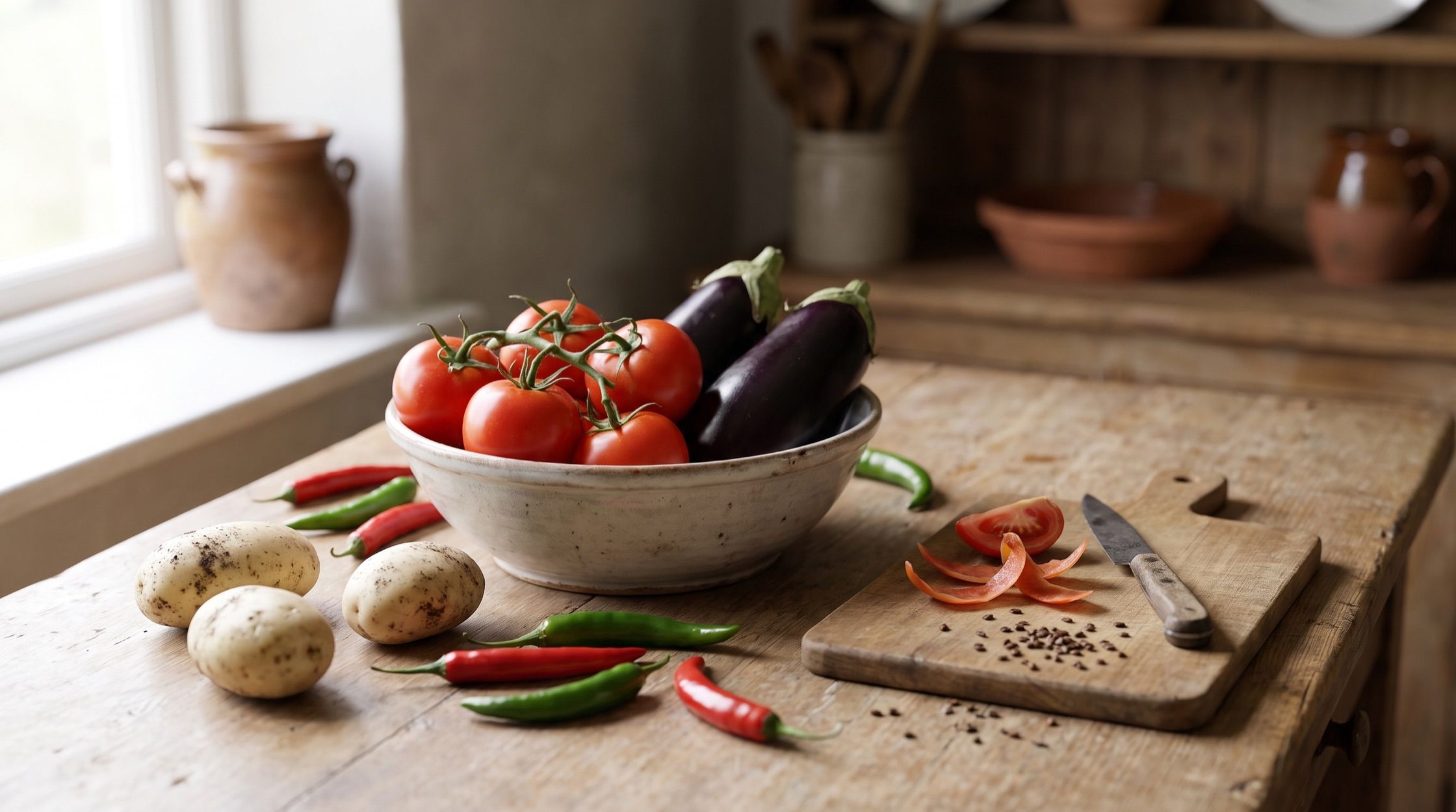
The four that matter clinically are tomatoes, peppers, eggplant and white potato. The wider Solanaceae family also takes in tomatillos, goji berries, cape gooseberries, ashwagandha and tobacco. Sweet potatoes, black pepper and mushrooms are not nightshades, whatever the lists online tell you.
- Tomatoes in every form: fresh, canned, jarred sauce, paste, ketchup, sun-dried.
- White potatoes and everything made from them, potato starch included.
- Eggplant, including baba ganoush and anything else built on it.
- All Capsicum peppers. Bell peppers, chili, jalapeño, cayenne, and paprika, which hides in more spice blends than people realize.
- Tomatillos, goji berries, cape gooseberries and pepino melon.
- Ashwagandha. This one catches people off guard, because it turns up in sleep and stress formulas and the label rarely mentions the family it belongs to.
- Tobacco, which is where the family gets its name and most of its reputation.
Things that are not nightshades, despite appearing on a lot of lists: sweet potato and yam, black pepper (an entirely different plant family), mushrooms, and blueberries. If you are going to run this experiment, run it on the right foods.
How do you find out whether nightshades affect you specifically?
You remove them completely for a defined window, keep everything else the same, then put them back and watch what happens. A diet is a tool with an entry, a trial, a target and an exit. The reintroduction is where the answer actually lives.
The framing matters, because it is what stops this from becoming a permanent restriction you never really chose. A diet is not a drug. It is low risk, it is reversible, and it is yours to control. You pick it up, you use it, you put it down. The moment your diet becomes who you are, you stop asking the only question that matters. Is it working?
- Pick the window before you start. A week is usually enough to feel something, and two weeks removes the argument. Anyone can do seven days. Willpower gets you three days, three weeks, three months, and after that willpower always loses. So set the end date on day one.
- Take out all of it. Every tomato, every pepper, every potato, the paprika in the spice rub, the ketchup. A partial elimination gives you nothing. Half in is out.
- Change nothing else. No new supplement, no new training block, and don’t start this the same week you give up alcohol. If three variables move at once, the result teaches you nothing.
- Write down what you are tracking, in advance. Morning stiffness and how long it lasts. Grip strength when you open a jar. Which joints, and at what time of day. Also bowel movements, bloating and stool consistency, because the gut usually answers before the joints do.
- Then bring them back properly. A real portion, on an ordinary day. This is the test. Everything before it was setup.
Most of the time diet gives you feedback quicker than you think. If you change what you eat, you should feel something different.
What does a short elimination trial actually tell you?
It tells you your symptoms respond to food, and that your immune system is being activated by something you are eating. It does not tell you that nightshades are the solution. It gives you information. That was the point.
That distinction gets skipped constantly, so let me be blunt about it. When we run a seven-day carnivore challenge with someone who has inflammatory bowel disease and their symptoms drop significantly, that is a diagnostic result. Their gut is reacting to something they eat. Remove the activators and the symptoms go away. Now we have learned something, and we can work out how to use it to their advantage.
Then comes the exit, which is the difference between a tool and a religion. Usually the exit means going from doing this 100% down to about 75%. People say some version of: I feel good, I don’t want to ruin this. Fine. If we removed a dozen foods, you might find six you have no interest in getting back and four you would like in small amounts. That is a plan. The other version, where you never eat any of it again because you once suspected it, is just a habit nobody ever revisited.
Be honest about the confounds while you are at it. Cutting nightshades usually means cutting fries, pizza and potato chips at the same time, and losing a few hundred calories of processed food along with them. Arthritis also flares and settles on its own, so a flare that was already easing can quietly get credited to the diet. This is precisely why the reintroduction matters more than the elimination. A symptom that reliably comes back when the food comes back, twice, is a far stronger signal than one good week.
Who should not bother cutting them out?
If you have no autoimmune diagnosis, no joint symptoms and no gut symptoms, there is nothing here for you. Nightshades are not a general health hazard. And for some people a restrictive elimination diet carries real risk that outweighs the question it might answer.
- Anyone with a history of an eating disorder. People with eating disorders apply a set of irrational rules, and we are applying rational ones, but they are still rules, and the rule itself can be the trigger. This is the exception I am most careful about.
- Anyone with type 1 diabetes or on insulin. Removing a whole carbohydrate group changes your requirements, and that is a conversation with the doctor managing your insulin, not something to run off an article.
- Older adults at risk of losing muscle. Nothing is more important to your long-term health than your muscle. If an elimination diet drops your protein intake or flattens your appetite, it is costing you more than it can give back.
- Anyone already eating a narrow diet. Taking more foods off a short list is how deficiencies get made.
For everyone else, a properly run one-week trial costs close to nothing. You take one food group out for a week, then you put it back. So run it. Arguing about it online takes longer.
Two things to hold on to. First, none of this is a diagnosis. If your joints hurt, get properly assessed, because rheumatoid arthritis, psoriatic arthritis and half a dozen other conditions need treatment that food does not replace. Second, treating disease is complicated, but moving toward health is simple. You remove the interference and you add the sufficiency. That is true for the healthiest person reading this and for the sickest, and it does not require you to become anybody’s idea of a purist about tomatoes.
References
- Childers, N. F., & Margoles, M. S. (1993). An apparent relation of nightshades (Solanaceae) to arthritis. Journal of Neurological and Orthopedic Medical Surgery, 12, 227–231.
- Friedman, M. (2006). Potato glycoalkaloids and metabolites: roles in the plant and in the diet. Journal of Agricultural and Food Chemistry, 54(23), 8655–8681.
- Patel, B., Schutte, R., Sporns, P., Doyle, J., Jewel, L., & Fedorak, R. N. (2002). Potato glycoalkaloids adversely affect intestinal permeability and aggravate inflammatory bowel disease. Inflammatory Bowel Diseases, 8(5), 340–346.
- Iablokov, V., Sydora, B. C., Foshaug, R., Meddings, J., Driedger, D., Churchill, T., & Fedorak, R. N. (2010). Naturally occurring glycoalkaloids in potatoes aggravate intestinal inflammation in two mouse models of inflammatory bowel disease. Digestive Diseases and Sciences, 55(11), 3078–3085.
- Darlington, L. G., Ramsey, N. W., & Mansfield, J. R. (1986). Placebo-controlled, blind study of dietary manipulation therapy in rheumatoid arthritis. The Lancet, 327(8475), 236–238.
- Kjeldsen-Kragh, J., Haugen, M., Borchgrevink, C. F., Laerum, E., Eek, M., Mowinkel, P., Hovi, K., & Førre, O. (1991). Controlled trial of fasting and one-year vegetarian diet in rheumatoid arthritis. The Lancet, 338(8772), 899–902.
- Hagen, K. B., Byfuglien, M. G., Falzon, L., Olsen, S. U., & Smedslund, G. (2009). Dietary interventions for rheumatoid arthritis. Cochrane Database of Systematic Reviews, (1), CD006400.