Red Yeast Rice vs Statins: A Pharmaceutical Grade Supplement
Is red yeast rice actually a statin?
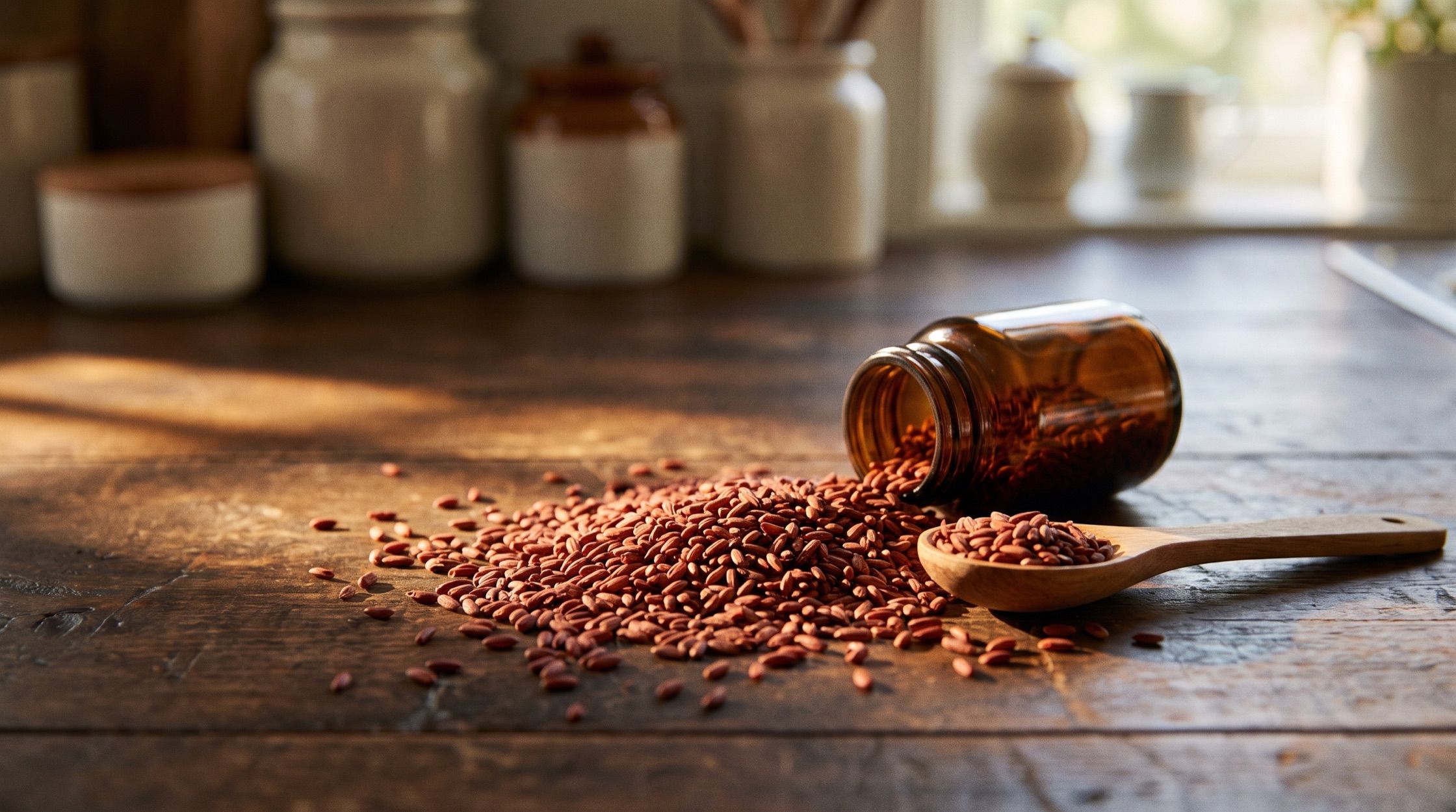
Yes, in the way that matters. Red yeast rice that has been fermented on rice produces monacolin K, and monacolin K is chemically identical to lovastatin, a prescription statin. The plant did the same chemistry a lab later copied, which is why the supplement behaves like the drug in your body.
Statins didn’t appear out of nowhere in a pharmaceutical lab. Researchers developed them in the 1970s because of what they already understood about what red yeast rice does in the body. Monacolin K and lovastatin are the same molecule. One just comes with a prescription and a dosage you can trust, and the other comes in a jar on a supplement shelf.
I tell patients this and they’re usually surprised, because “natural” and “drug” feel like opposite categories. People search for “natural statin alternatives” and land on red yeast rice, assuming natural means separate from pharmaceutical. It doesn’t. Nature invented a lot of our drugs first. We just figured out how to isolate, standardize, and dose them.
Why are supplements not all one category?
Because they aren’t. I put supplements into three buckets: nutrients your body can’t make and needs from outside, compounds that enhance performance when taken in a concentrated dose, and substances that are, in effect, medicine. Treating all three the same way is where people get into trouble.
The first group is nutrients you need but can’t make: magnesium, vitamin D, vitamin A, B12, folate. Most of us living under fluorescent lights and eating from a narrow rotation of foods don’t get enough of them from diet and sun alone. Then there’s performance enhancement: creatine, L-glutamine, and acetyl cysteine, ordinary components of food taken in a concentrated dose well beyond what a normal meal delivers. And then the one people miss: medicine wearing a supplement label. Red yeast rice and berberine belong here. Neither is filling a nutritional gap. Both are doing what a prescription drug does, through a real mechanism, at a dose that changes your physiology.
The mistake is assuming a supplement is safe by default because it sits next to the vitamins instead of behind a pharmacy counter. Something like red yeast rice extract is sold over the counter because it’s an extract from a plant, but it still has a statin-like effect once it’s in your body.
Which supplements are really medicine in a different bottle?
Red yeast rice extract and berberine are the two that come up most often. Both have a measurable effect on your physiology, and both share a mechanism with a prescription drug class. Give them the same respect you’d give a pill from a pharmacy.
Red yeast rice also isn’t standardized the way a prescription is. Because it comes from a fermentation process rather than a lab-controlled synthesis, two bottles from two different manufacturers can end up with very different amounts of monacolin K. You could be taking a meaningful statin dose or almost nothing, and the label alone won’t reliably tell you which.
What does that mean for side effects and for combining them?
It means the side effects run the same as a statin’s, because it’s the same drug. Combining red yeast rice with a prescription statin means combining two doses of essentially the same medication, not something to figure out on your own. This is exactly the kind of decision that has to go through your prescribing physician, not a supplement aisle. If you’re on a statin and also taking red yeast rice, you’re doubling up on essentially the same medication, and your prescriber needs to know that. Your doctor needs full visibility into everything you take so your labs and your muscle symptoms make sense, and so nobody is surprised by a set of liver enzymes that looks wrong for the dose that was actually prescribed.
I’m not telling you to start or stop anything here. That’s a conversation for the person managing your prescriptions. What I want you to walk away with is the category. Once you know red yeast rice sits in the same bucket as a statin, the rest of the decision-making follows the same rules you’d already apply to any medication.
Where does berberine sit?
In the same bucket as red yeast rice. Berberine is a plant alkaloid, a defense chemical the plant makes to protect itself, and it has a real effect on blood sugar, the gut microbiome, and immune signaling. Take enough of it and you’re not supplementing. You’re medicating.
Part of why people compare berberine to metformin isn’t hype. It has a measurable effect on blood sugar regulation, and that’s exactly why berberine and a statin, or berberine and a diabetes medication, aren’t automatically safe to stack without someone watching your labs.
The plant alkaloid part matters more than people realize. Plants don’t make defense chemicals to be helpful. They make them to be potent enough that something eating the plant notices. That potency is exactly what makes berberine useful medicinally, and exactly why “more must be better” is the wrong instinct to bring to it.
How should you actually think about buying a supplement?
Ask why before you ask which. What are you trying to correct, and what food or habit isn’t covering it? A supplement should have a reason and, most of the time, an end date. It shouldn’t be a purchase you make because a name you recognize was promoting it on a talk show.
I don’t get involved in “I heard this was good” decision-making, and I’d encourage you not to either. The guy behind the counter at the supplement store isn’t wrong to be enthusiastic. He’s just not working from your blood chemistry. I take three to five supplements myself on a regular basis, and it changes with the season and what’s going on in my life. Vitamin D is close to permanent for me, because unless you’re a lifeguard, you’re not making enough of it under fluorescent lights and a car windshield. Magnesium has crept in as I’ve gotten older. Omega-3 is there because I’m not eating three cans of sardines a day, and if I were, I’d drop it.
That’s the test I’d apply to red yeast rice or berberine or anything else in that medicine-in-a-different-bottle category. Know what it’s actually doing in your body, know what else you’re taking that does something similar, and let the person managing your prescriptions see the whole list. A supplement earns its place by closing a specific gap. It doesn’t get a permanent seat just because it’s easier to buy than a prescription.