Thin, Sagging Skin on Your Arms (Crepey Skin): What Causes It and Why Moisturizer Won’t Fix It

A member on one of our Reset Room calls, the live group sessions where people bring their labs and their questions straight to me, turned her arm over on camera and showed us the skin on her forearms: thinner than it used to be, looser, with a fine crinkle across it like tissue paper. Crepey skin, people call it, after crepe paper. She’s 71. Then she asked the better question: “If that’s starting to get on my outside, what’s going on my inside?”
She was right to ask it that way.
Skin isn’t a separate organ bolted onto the outside of you. It’s built out of the same protein and the same fat as everything underneath it, and it’s fed by the same bloodstream. So when the surface starts thinning and creasing, the reasonable assumption is that the same process is running in places you can’t see.
What causes thin, sagging skin on the arms?
Thin, sagging skin is a structural problem happening below the surface. The collagen and elastin in the deeper layer of the skin thin out, so the skin loses its elasticity; the muscle underneath the skin shrinks; and the diet stops supplying enough protein and fat to rebuild either one. Age accelerates all three.
Think of it as a speed setting. You’ve probably listened to a podcast at 1.25 to get through it faster. We want our lives running at 1.0, or even 0.9. Just a little slower. If you’re living in a way that has you aging at 1.25 or 1.5, you’re aging faster than you should be, and the arms are one of the first places that shows. I don’t know that you can put a number on anyone’s personal speed setting. I do know that nutrition, exercise and sleep move the dial, and that the fancy tech guys promising to make us live forever have not convinced me they’re doing anything more useful than that.
And here’s the part of her question I care about most. Picture a baby’s skin next to a senior citizen’s skin. One is plump and smooth, the other is drier, thinner, more wrinkled. Now picture the lining on the inside of your blood vessels. You do not want that lining looking like the second one, because dry, aged tissue cracks, and cholesterol seeps into the cracks. Loose, wrinkled skin on your arms doesn’t prove that’s happening. It’s a reasonable prompt to go look.
Why doesn’t moisturizer fix sagging skin?
Because a moisturizer works on the outermost layer of the skin and the sagging is a problem in the layer beneath it. Cream sits on the outer layer and softens it. It can’t rebuild collagen, it can’t restore elasticity, it can’t add muscle volume back under the skin, and it can’t supply the fats your body uses to make its own oil.
Aging skin is something a lot of cosmetic companies capitalize on. There’s a whole industry of lotions and potions and serums for fine lines and wrinkles, and they are sold hard to women in their sixties and seventies in particular.
We know that the health of our skin is really coming from the inside, and from what comes out from the inside.
I’m not telling you to throw out your moisturizer. Use it. It makes skin more comfortable and it’s a fine thing to do. Just don’t expect a topical product to solve a problem that starts with what’s on your plate and how much muscle you’re carrying.
What does muscle loss have to do with sagging skin?
Your skin drapes over your muscle. If the muscle underneath stays large, the skin stays tight across it. If the muscle shrinks, the skin gets looser over the same frame. That is a large part of what people are describing when they notice loose skin on their arms.
Here’s the way I explain it in clinic. If you weigh 130 pounds at 20 years old and you weigh 130 pounds at 60, the scale says nothing changed. Your body looks completely different. You naturally have less muscle at 60, and less muscle means less bone. The weight got made up somewhere else.
Bones and muscle are your main organs. That’s longevity. Everyone’s attention goes to the heart and the brain, and then they spend thirty years quietly giving away the tissue that determines whether they can get off the floor at 80.
Which is why the answer to loose, sagging skin involves resistance exercise, and why it involves eating differently as you get older: less carbohydrate, more protein and fat, so you have the raw material to hold on to muscle and bone. Optimize those tissues and the skin sitting on top of them has something to sit on.
Which nutrients does skin elasticity depend on?
Protein and fat. Skin structure is protein, and the oil that keeps skin from drying out is made from fat. The older you get, the more of both you need. One of the best ways to keep your skin healthy is protein and fat, at every meal.
I always say protein and fat together, because in real food they always arrive together. Always. Carbohydrate and fiber are the other pair. Eat an apple, that’s carbohydrate and fiber. Eat broccoli, carbohydrate and fiber. Eat a steak, protein and fat. You almost never find carbohydrate and fat sitting together in nature. Avocado is the famous exception, and even there it’s mostly fat and fiber.
Then there’s the processed food world, which exists to break that rule. Take wheat, strip the fiber out of it, keep the carbohydrate, turn it into dough and fry it in fat. Now you have a donut. Or a Danish, or pizza, or chips. Fat and carbohydrate together produce the most addictive foods on earth, the ones you genuinely cannot eat just one of. Your body was never built to meet those two in the same bite.
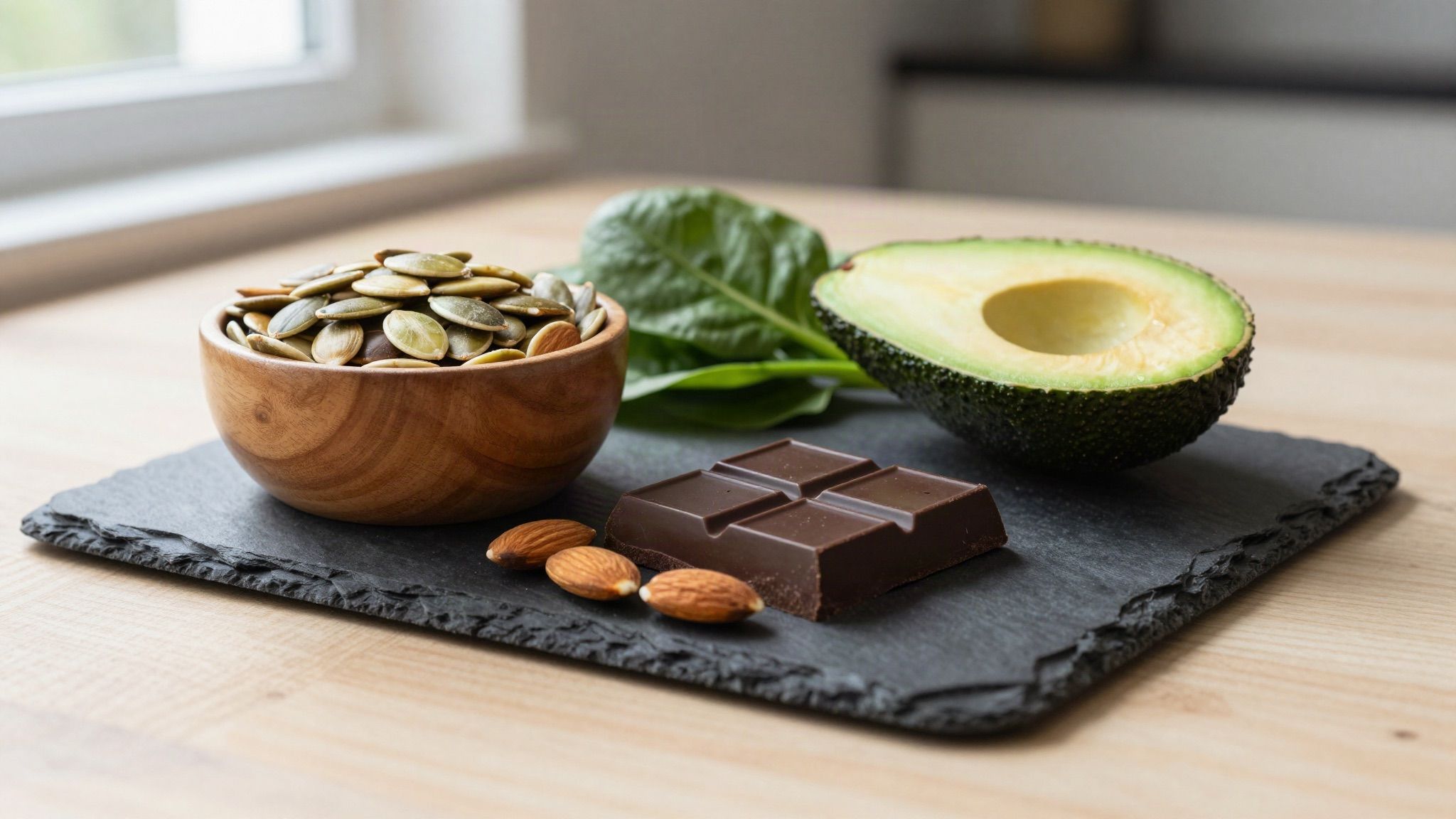
For skin specifically, the fats found in well-raised animal foods are doing the work:
- Fatty fish, which most people I see are not eating enough of
- Eggs, whole, including the yolk that everyone spent thirty years throwing away
- High quality red meat, which is protein and fat in one package
- And the protein alongside it, at a real serving size, the kind that covers a third of the plate
There’s a circulation piece too. Nitric oxide is one of those molecules your body makes that declines steadily with age, and it protects the lining of your blood vessels. Vegetables give you the nitrates your body converts into it, and beets are unusually concentrated, which is why I like a dehydrated beet powder for anyone carrying cardiovascular risk. It does lower blood pressure, which is largely the point of it, so if you’re on blood pressure medication or on nitrates, clear it with whoever prescribes them before you start. Probably best taken at night.
Small aside that surprises people: you make nitric oxide in your mouth and nose while you sleep, so if you snore, sleep with your mouth open, have sleep apnea or wake up with a bone dry mouth, your nitric oxide plummets overnight. Inflamed gums do it too. Fix the mouth and you’ve fixed something the supplement can’t.
Does taking collagen help wrinkled, sagging skin?
The evidence is for skin elasticity and hydration, which are the properties that go when skin turns thin and crepey. So yes, it’s worth taking, and collagen is one of the few supplements I’ll recommend without ordering a blood test first. Collagen is the most abundant protein in your body. The amino acids in it feed skin, joints, tendons, ligaments and bone. I treat it as food more than as a supplement.
Technically it’s a peptide: a chain of amino acids, more than a single amino acid and less than a whole protein. That matters mostly because it’s easy to absorb and easy to add to coffee or a smoothie. Collagen is a particularly good idea if you’re not getting as much protein as you think you are, which is a lot of people once appetite and digestion start to fall off.
It helps to know that nutritional supplements come in three different categories, because people take them all the same way and they shouldn’t:
- Vitamins and minerals. You take these because a test says you’re low. Vitamin D, magnesium, B12.
- Food components like collagen peptides, creatine and amino acids. These are concentrated food. You can take them long term.
- Plant medicines like berberine, turmeric and ashwagandha. These are plant defense chemicals, and the benefit comes from your body’s response to a mild toxin. Turmeric is mildly inflammatory, and your anti-inflammatory response to it is the whole point. These are for a desired effect over a period of time, and they are not nutrients you’re missing.
Collagen sits in the middle group, which is why I tell people to put it on the grocery bill instead of the supplement bill.
Compare that to a one-a-day multivitamin, which I’m not a fan of. All that micronutrition gets compressed into one dense tablet and then you hope your stomach acid can take it apart. People who clean portable toilets will tell you they find tablets with the brand name still readable on them. That’s hearsay, and I’ll call it hearsay. The mechanism behind it is real though: a densely compressed tablet is a lot to ask of your stomach acid, and your stomach acid does less as you get older.
The published work on collagen and skin is better than most supplement research. Proksch and colleagues, in Skin Pharmacology and Physiology in 2014, gave 69 women aged 35 to 55 either 2.5 or 5 grams of collagen peptides daily for eight weeks and measured a significant improvement in skin elasticity against placebo. In the older women in that trial, the effect was still measurable four weeks after they stopped. A 2021 systematic review and meta-analysis by de Miranda, Weimer and Rossi in the International Journal of Dermatology pooled 19 trials covering more than 1,000 people and found improvements in skin hydration and elasticity, with most trials running around 90 days.
How long does it take to see a change?
Give it three months before you judge it. The collagen trials that show a measurable change in elasticity run eight to twelve weeks. Muscle rebuilt with protein and resistance training moves on a similar clock. Nothing you do to your skin from the inside shows up in a week.
That’s the reason our reset runs 90 days with blood work at both ends. You get a set of markers at the start, you change what you eat and how you move and how you sleep, and then you look again. Some of what improves you’ll feel long before you see it, because energy and sleep respond faster than connective tissue does.
Speaking of which, don’t skip the sleep part. I got to meet Matt Walker, one of the leading voices on sleep science, and the thing that stays with me is that there is no animal on this planet that doesn’t sleep. If evolution could have built a creature that skipped it, it would have, because nothing is more vulnerable than an animal asleep in the wild. It didn’t. Sleep is an active repair process, and it’s the best longevity drug that exists. Manage your light after dinner, get bright daylight in your eyes before 9am with nothing between you and the sky, and walk outside at dusk with the screens off.
So the short version for anyone watching the skin on their arms thin out and sag: eat protein and fat at every meal, lift something heavy a few times a week, add collagen and treat it as groceries, get your circulation and your sleep sorted, and get the blood work done so you know where you actually stand. The cream is optional. The rest of it is the actual mechanism.
One caveat, as always. This is general education, not advice about your particular situation. If your skin has changed quickly, or it’s changing alongside fatigue, bruising or weight loss, go see your own clinician and get some labs run. That’s a conversation to have, and no supplement substitutes for it.